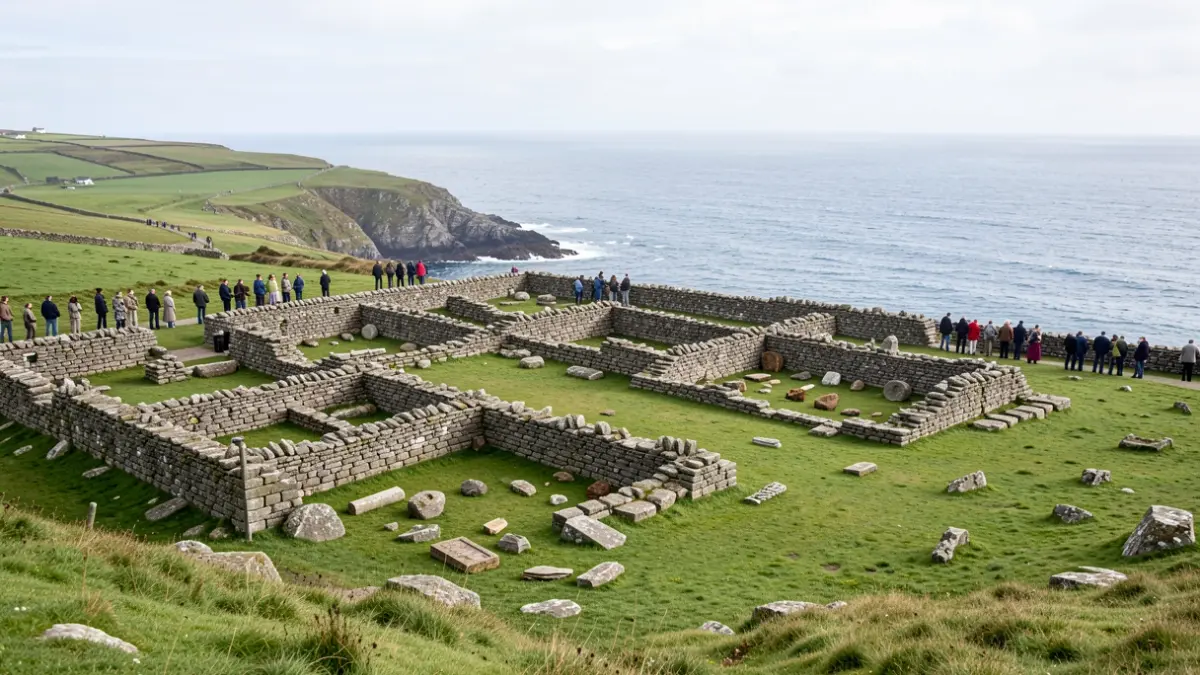
The project, funded by the Atlantic Islands of Galicia Maritime-Terrestrial National Park, focused on concluding archaeological work and conserving the structures. Previous excavations had already indicated the castro was inhabited for nine centuries, with Castro occupations inside the wall and Roman settlements in the lower areas, including fish salting factories on Canexol beach.
Excavations conducted in the spring east of the fortified zone had already suggested a Roman expansion beyond the defensive limits. This second phase confirmed the existence of a Roman-era building and located a Castro-era wall beneath the Roman levels, marking the campaign's main novelty. Intervention director Alba Rodríguez highlighted the need for continued work to understand the occupation patterns in this area.
Furthermore, on the intermediate terrace of the castro, where Iron Age structures were previously found, excavation continued on a hut identified in 2025, leading to the discovery of three other partially excavated dwellings. The excavation of a large dwelling with a possible central combustion structure was completed, and a structure of embedded flagstones was found. A new curved wall was also documented, bringing the total number of detected dwellings on this terrace to five.
“"This discovery reinforces the hypothesis that this area of Castelo dos Mouros had a continuous and complex occupation."
The campaign also included structural conservation work, such as stabilizing an exterior wall in delicate condition. Archaeologists including Patricia Valle, Nerea Ruanova, Raúl Méndez, and doctoral students participated, along with island rangers and the company Tragsa. The intervention also had a training and outreach component, with visits from specialized guides and students from the Higher School of Conservation and Restoration of Cultural Heritage of Galicia.