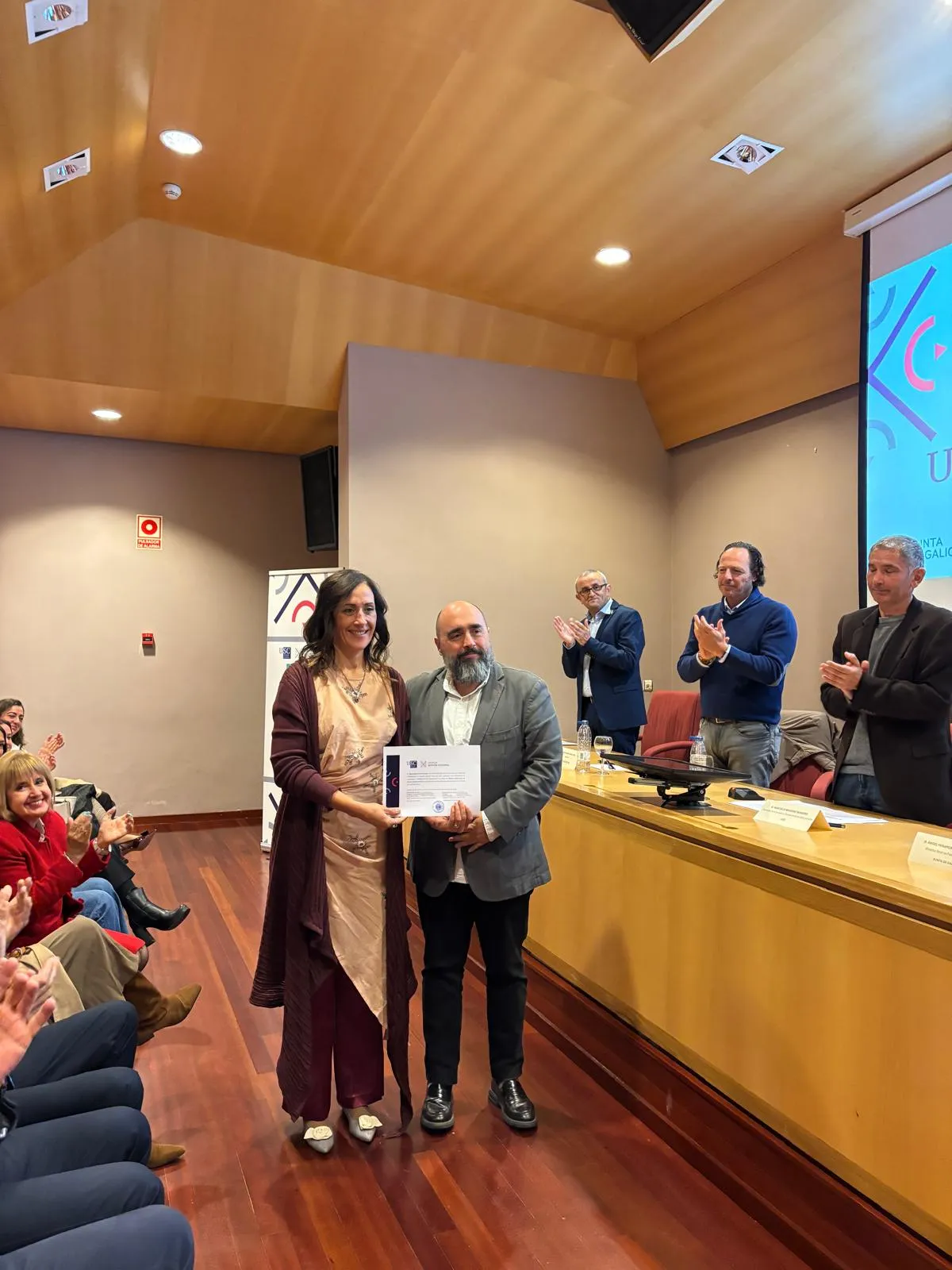
The work, published by the University of Vigo's Publications Service, was presented this Friday in the degree hall of the Faculty of Biology. The author was accompanied by the Professor of Zoology and former UVigo Rector Salustiano Mato, and the Director of the Publications Service, David Tizón.
The Director of the Publications Service described the publication as "an exceptional milestone in the world of Biology, a unique work of its kind that resolves a historical problem: the lack of proper names for invertebrates in our languages." He highlighted its dual version, digital and in print, as "a true collector's item" available at an accessible price.
Salustiano Mato, in turn, praised the figure of Carlos Garrido, emphasizing the combination of zoology, terminology, and specialized translation knowledge required for a work of this magnitude. He recalled the tool's importance for teachers who conduct classes in Galician, enabling them to "be careful and rigorous" in their use of terms.
The author himself explained that the 1356-page volume offers an extensive repertoire of scientific, paracientific, and vernacular names for protozoa and invertebrate animals. Identified by the acronym DZZI, it contains approximately 180,000 terms and 28,000 zoonymic entries, making it one of the largest zoology dictionaries in existence.
This is the third version of a project initiated in 1997. The current edition significantly expands upon previous work, incorporating a repertoire of vernacular names to fill gaps in invertebrate nomenclature and developing new names in Galician-Portuguese and Spanish based on English and German terms through "careful semantic tracing".
The work uses the label 'português' to identify the Galician-Portuguese language, including Galician, Portuguese, and Brazilian variants. This perspective is particularly relevant for zoological terminology, where the diversity of names can hinder precise identification and translation.