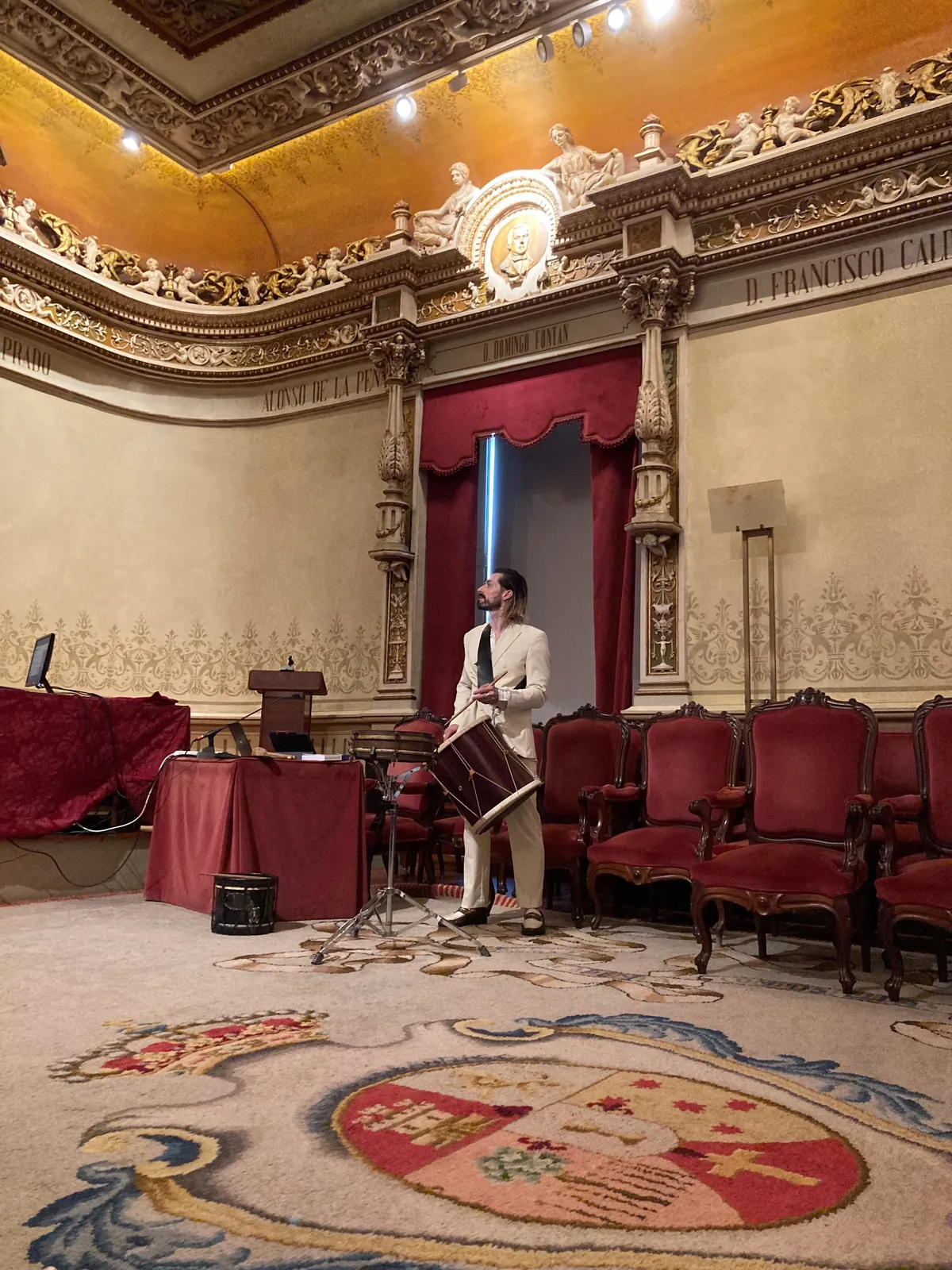
The doctoral thesis by Cristian Silva Bóveda, defended at the University of Santiago de Compostela (USC), focuses on traditional Galician percussion, an "overlooked" element of the country's musical historiography. The research, titled ‘O ruído: a percusión como acompañamento da gaita na Galicia do S. XX. instrumentos, intérpretes e padróns rítmicos’ (Noise: Percussion as accompaniment to the bagpipe in 20th-century Galicia. Instruments, performers, and rhythmic patterns) and supervised by Professor Francisco Javier Garbayo Montabes, analyzes the evolution of this heritage from an ethnological, technical, and historical perspective.
Silva Bóveda's study highlights the "historical invisibility" and "wage gap" suffered by percussionists (drummers, snare drummers, or bombistas) compared to bagpipers. The research indicates that percussionists "systematically received lower remuneration" and their names were "almost constantly omitted from posters, programs, and historical records," often appearing as "servant" or "boy." The thesis also reinterprets the popular concept of ‘ruído’ or ‘arruídos’ (noise), demonstrating it was an expression of "pride and popular identity" in the Rías Baixas and the rest of Galicia.
The empirical research isolated traditional rhythmic rudiments and patterns by analyzing historical recordings from the 20th century, featuring figures such as the gaiteiros de Soutelo and Os Campaneiros de Vilagarcía. This scientifically validates the existence of a Galician School of Percussion, defining a unique grammar and rhythmic patterns for various types of dances.
The thesis also addresses the "pedagogical and technological revolution of the 21st century," from the first written methods of Galician drumming to high-definition virtual sampler banks. Silva Bóveda states that "percussion was never a mere human metronome or an intuitive accompaniment without value, but a first-class cultural and technical system," aiming to "restore to percussionists the central place they have always held in our music."