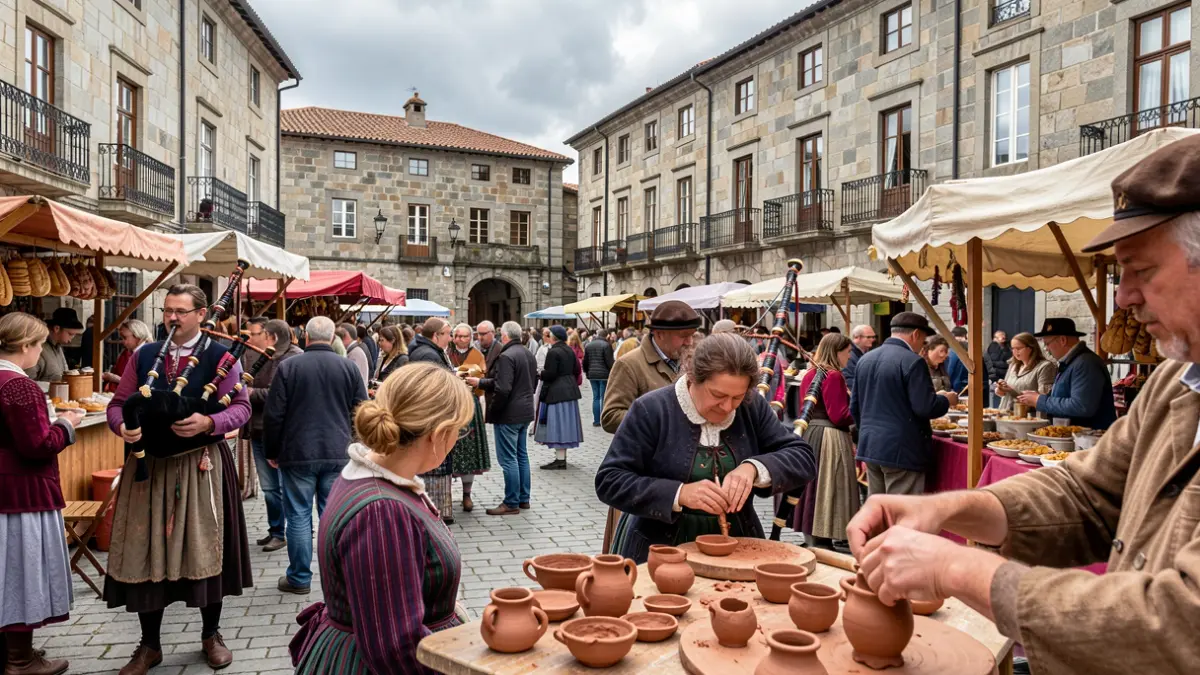
The University of Santiago de Compostela (USC) is joining the European doctoral network SOPHIA-DN, an initiative dedicated to researching ceramic heritage and artisanal techniques passed down through generations. USC will be responsible for training two of the fifteen doctoral candidates participating in this project, whose research will be conducted at the Interdisciplinary Research Centre of Cultural Atlantic Landscapes (CISPAC), in collaboration with the Department of History.
This network, coordinated by the University of Cyprus, has substantial European funding of €4,309,766.28, of which €564,376.32 will be managed by USC. SOPHIA-DN will commence on March 1, 2027, and will run for four years under the prestigious Marie Skłodowska-Curie actions of the Horizon Europe program. The proposal achieved a notable score of 95.2 out of 100 in the Social Sciences and Humanities panel.
USC's scientific representation in the project falls to Silvia Amicone, a Ramón y Cajal researcher from the Department of History and CISPAC, who will supervise the two doctoral investigations. Additionally, the university's team includes María Pilar Prieto Martínez, José Carlos Sánchez Pardo, and Óscar Lantes Suárez.
The SOPHIA-DN project aims to analyze the origin and evolution of artisanal traditions, as well as the connections between communities from different territories. Ceramics will serve as a focus to investigate raw material selection, manufacturing processes, and the dissemination of techniques and objects. The network's name, derived from the Greek word 'sophia' (wisdom), refers to the knowledge accumulated by potters through practice and intergenerational transmission. The research will combine scientific material analysis, experimental archaeology, archaeological interpretation, and artificial intelligence, covering periods from the Neolithic to the post-medieval era across Europe, the Eastern Mediterranean, Africa, and the Arabian Gulf.
At USC, the two doctoral projects will address complementary perspectives. One will focus on the production and use of carbon-based pigments and ceramic surface treatments, while the other will analyze the relationship between raw materials, ceramic provenance, and its circulation. For this, the analytical infrastructures of USC's Unit of Archaeometry and Materials Characterization will be utilized.
The consortium comprises twenty organizations from six European Union countries, including eight beneficiary entities and twelve associated partners. Alongside USC and the University of Cyprus, participants include the Cyprus Institute, the Universities of Padua, Patras, and Pisa, University College Dublin, and France's Centre National de la Recherche Scientifique (CNRS). The network also incorporates heritage organizations, a pottery workshop, and a technology company.
The fifteen doctoral researchers will receive specialized supervision, undertake placements at other consortium institutions, and participate in a common training program. Their selection is anticipated between September and November 2027, following open, transparent, and merit-based procedures, which will be announced on EURAXESS.