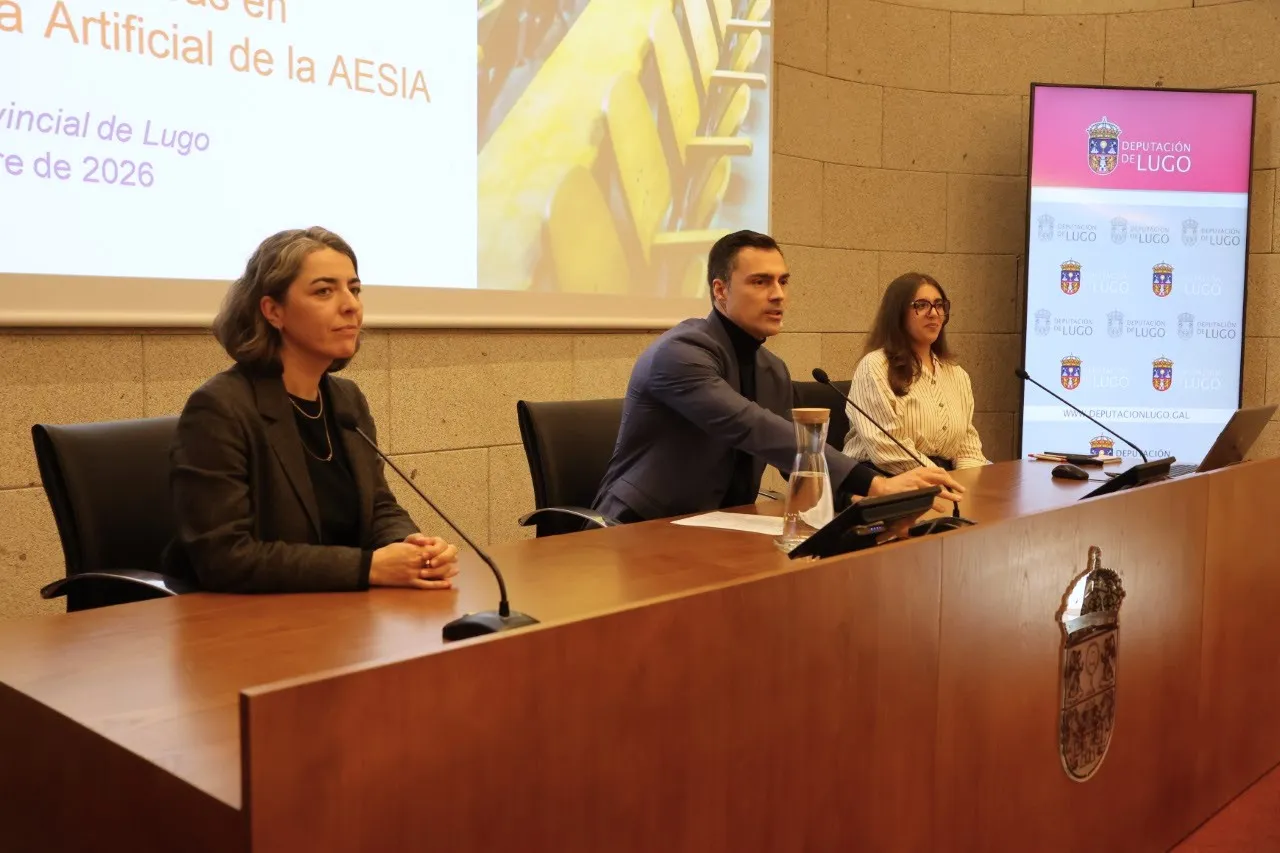
The event, organized by AESIA, provided the public with basic knowledge about artificial intelligence and the challenges of its use. The gathering brought together nearly 80 people in the auditorium of the Deputación, including professionals from the business sector, administrative offices, government, and the public interested in AI legislation.
Data collected by AESIA reflects diverse public perceptions: 29% consider artificial intelligence an unstoppable change, 26% see it as a threat, and 22% believe it needs to be governed, according to opinions gathered in its Ideas Laboratory.
The conference also addressed AI's role in spreading disinformation, highlighting the ability of these tools to create increasingly realistic fake images, videos, and audio, as well as to produce and propagate misleading content on a large scale. The importance of developing critical thinking and learning to verify information before sharing was emphasized.
Furthermore, the lower presence of women in the development of these technologies and the biases and stereotypes that systems can reproduce were analyzed, delving into the gender gap with consequences in areas such as employment, equal opportunities, and digital security. The contributions also aid in the analysis of data protection, minors, and labor market transformations.
The Deputy for Economic and Social Promotion, Pablo Rivera Capón, participated in the institutional opening, which also covered operational aspects and possibilities of artificial intelligence.
This event coincides with the development of the Deputación de Lugo's own artificial intelligence strategy, MencIA 2026-2030, aimed at studying and promoting the application of these tools in public services and municipalities within the province. The provincial institution's budgets for 2027 include an allocation to continue the development of this strategy.
The integration of artificial intelligence into public administration should be understood as a support tool for public employees, not a replacement, aiming to simplify tasks and expedite procedures while maintaining professional oversight and human judgment.