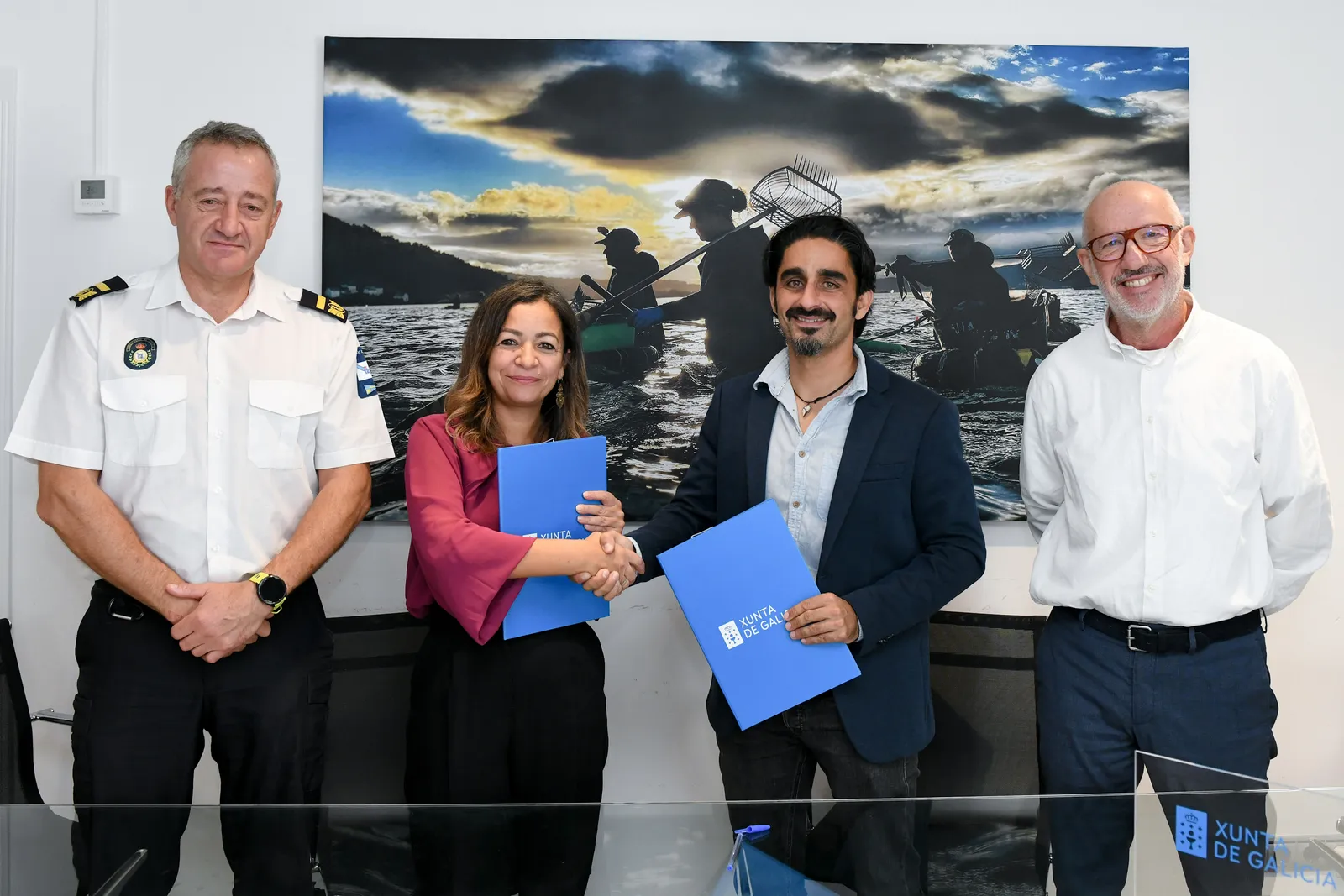
The Minister of the Sea, Marta Villaverde, formalized today in Santiago de Compostela a collaboration agreement with Octolarvae, an R&D&I regenerative aquaculture entity of the Profand group. The agreement's purpose is the development of joint tasks aimed at the recovery, controlled incubation of viable cephalopod egg masses, and the subsequent release of larvae and juveniles into the marine environment. The event was also attended by Octolarvae's technical director, Álvaro Roura Labiaga, Profand's Director of Sustainability, Antonio Álvarez, and the deputy director general of the Coast Guard Service of Galicia, Juan Carlos Codesido.
The agreement establishes a coordinated operational procedure to rescue eggs of species with high commercial and ecological value—such as the common octopus, cuttlefish, and squid—detected in illegal or unidentified fishing gear (the usual 'cacharros') removed by Coast Guard agents in Galician waters. The main objective is to minimize the mortality of these egg masses, leveraging their biological potential for regenerative aquaculture efforts and strengthening the recovery of natural populations in the estuaries.
The priority area of action covers the coastal strip between the Ría de Vigo and the Ría de Pontevedra, ensuring rapid response times due to the proximity of Octolarvae's facilities in Meira, municipality of Moaña. The protocol includes biological handling measures, with Coast Guard personnel responsible for keeping the egg masses in sacks with continuously renewed seawater until transport in approved tanks, documenting traceability through formal delivery and reception records.
All recovered biological material will be exclusively used for scientific research, assisted incubation, and potential repopulation releases, with any commercialization of the obtained eggs or larvae being prohibited. The agreement will have an initial duration of one year, extendable up to a maximum of four, and is part of the objectives of the Galician Plan for Research and Innovation 2025-2027 and the Smart Specialisation Strategy (RIS3).