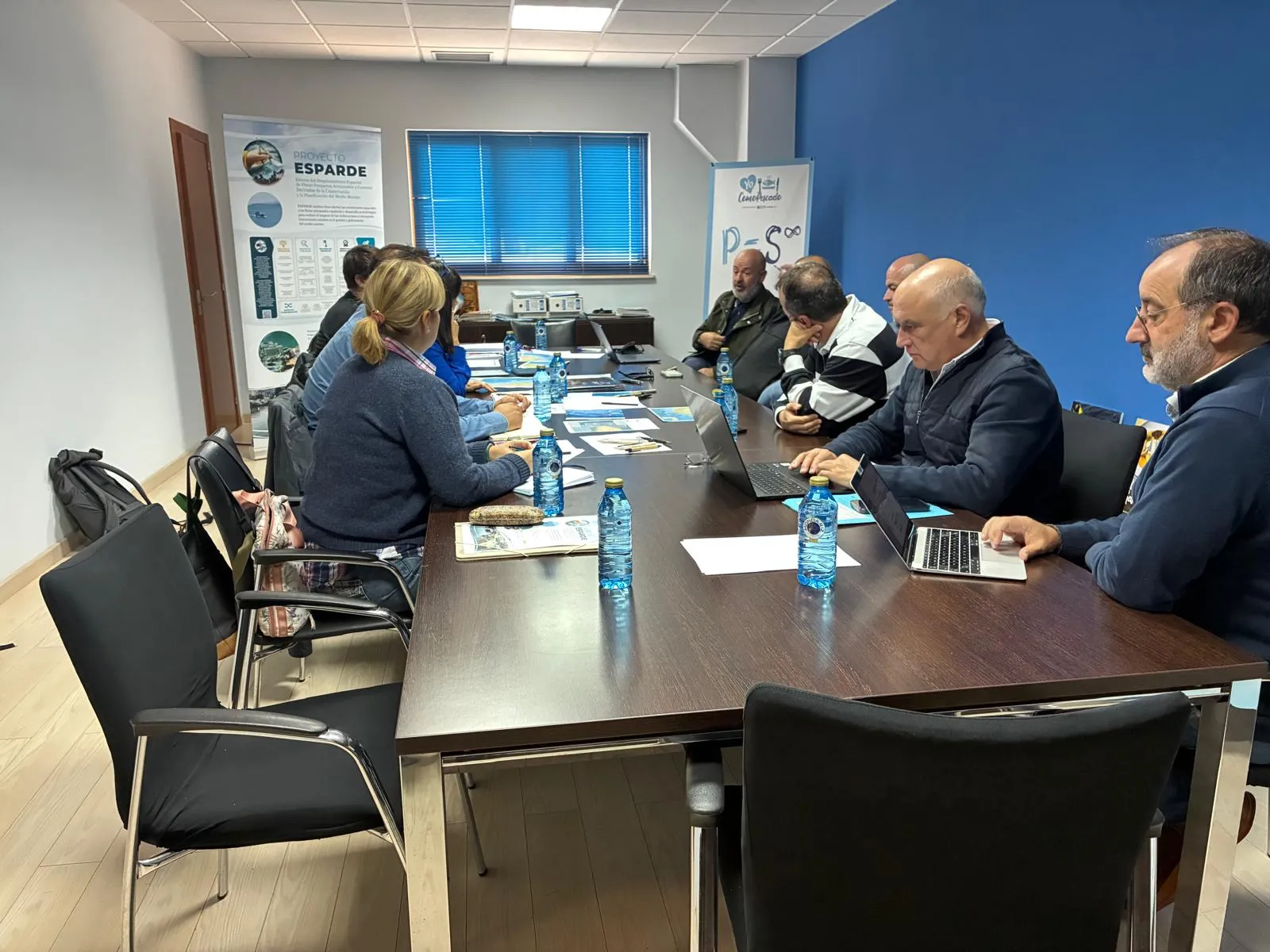
The Technological Centre for Marine Research (CETMAR), together with the University of Oviedo and the IEO-CSIC, opened a dialogue space in Burela with the artisanal fleets of northern Galicia. The meeting, held at the headquarters of the Fishermen's Organisation of Lugo, marks the beginning of an ongoing collaboration to analyze the effects of conservation and marine planning measures on the fishing sector.
This first formal meeting for the Galician pilot case, part of the ESPARDE project (Effects of spatial displacement of artisanal and coastal fishing fleets resulting from marine conservation and planning), was attended by the president of the Provincial Federation of Confrarías of Lugo, Basilio Otero, the manager of the OPP of Burela, Sergio López, and representatives of the trawl and purse seine fisheries.
Jose L. Santiago, coordinator of CETMAR's Fisheries Socioeconomics area, welcomed attendees and contextualized the fishing situation in Galicia. Subsequently, Laura García de la Fuente, ESPARDE coordinator and researcher at the University of Oviedo, presented the project and its scope, while Marta Ballesteros, a scientist at IEO-CSIC, laid the groundwork for collaboration, describing the specific Galician case and initiating a conversation that highlighted the needs of the fishermen and shipowners present.
The Galician pilot case focuses on the North Atlantic demarcation, where the coexistence of Vulnerable Marine Ecosystems (VMEs) and uses defined in the Maritime Spatial Planning will be studied, with particular emphasis on areas with potential for offshore wind energy (NOR2, NOR3, and NOR4). CETMAR and its partners aim to generate evidence applicable to the operational and socioeconomic reality of the sector, stressing the importance of sector collaboration for first-hand data to predict scenarios and improve management.
Sector representatives raised their current concerns, including fuel costs, temporary or permanent fishing closures, and the future of offshore wind energy. They also highlighted the variability of fleet displacements in Galicia and the need to measure socioeconomic impacts so that administrations can make informed decisions.
At the end of the meeting, it was agreed to hold further encounters to gather data and advance the ESPARDE project, described as ambitious and hopeful, with the aim of proposing appropriate management measures.
The ESPARDE project, framed within the Pleamar 2025 Programme, analyzes how marine protection and management measures influence the displacement of artisanal and coastal fishing in the Cantabrian Sea and the sustainability of fishing communities, seeking to understand the social, economic, and environmental effects of relocating small-scale fleets.