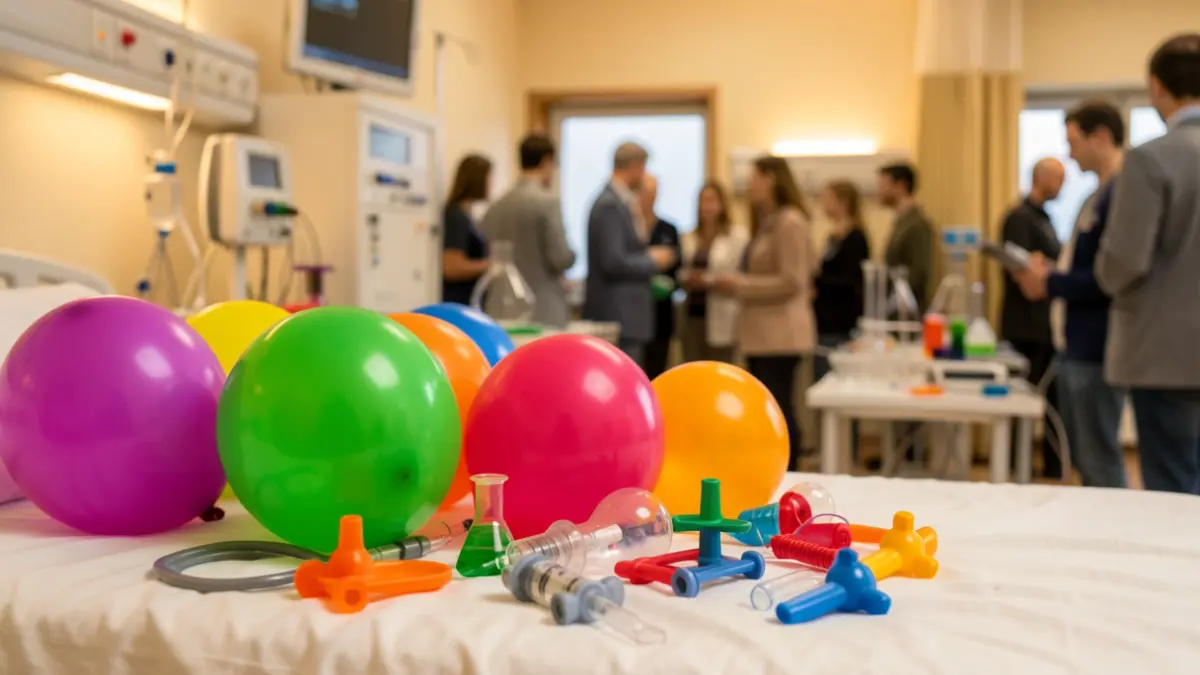
The ‘Aprender xogando nun hospital’ project, a Service-Learning (ApS) initiative from the Universidade de Vigo, aims to bring science to pediatric patients, making their recovery more entertaining. The activity involves conducting fun Fluid Mechanics experiments, such as understanding lung function with a balloon model or demonstrating Archimedes' principle with the 'Cartesian diver'.
A total of 60 students from UVigo's Biomedical Engineering program are participating in these outreach sessions, which will run until mid-December. Professor Eduardo Suárez Porto, the project's initiator, highlights that students apply their knowledge while developing skills like ethical commitment and social responsibility.
As a new addition this year, the Galician Association for Childhood and Adolescent Cancer (Asanog) is collaborating in liaising with clinical staff and patients, as well as managing the hospital classroom where the afternoon activities take place.
Experiments also include studying laminar flow, mixing water and cornstarch to create non-Newtonian fluids, or balancing a ping-pong ball with a funnel. The first session took place this Monday, and activities will continue every Monday afternoon until December 14.