The ALGa project began in the 1970s with the aim of studying the geolinguistic variation of spoken Galego in rural areas. It is part of the Biblioteca Filolóxica Galega collection, which emerged in the late 1990s under an agreement between the ILG and the Barrié Foundation to bring relevant philological research works to society.
The current Digital ALGa project represents a qualitative leap in the dissemination and use of one of the most important scientific resources for understanding the Galego language and its territorial diversity. The initiative allows access to information that was previously available mainly through printed volumes of the Atlas, in a swift and intuitive way.
The Galego Linguistic Atlas constitutes one of the most ambitious research projects carried out on the Galego language. Between 1974 and 1977, a team from the Instituto da Lingua Galega travelled through the Galician territory and neighbouring Galego-speaking areas to systematically document the speech forms of hundreds of informants. Using a questionnaire of nearly 3,000 questions, a vast amount of information on pronunciation, grammar and vocabulary used in different regions was collected.
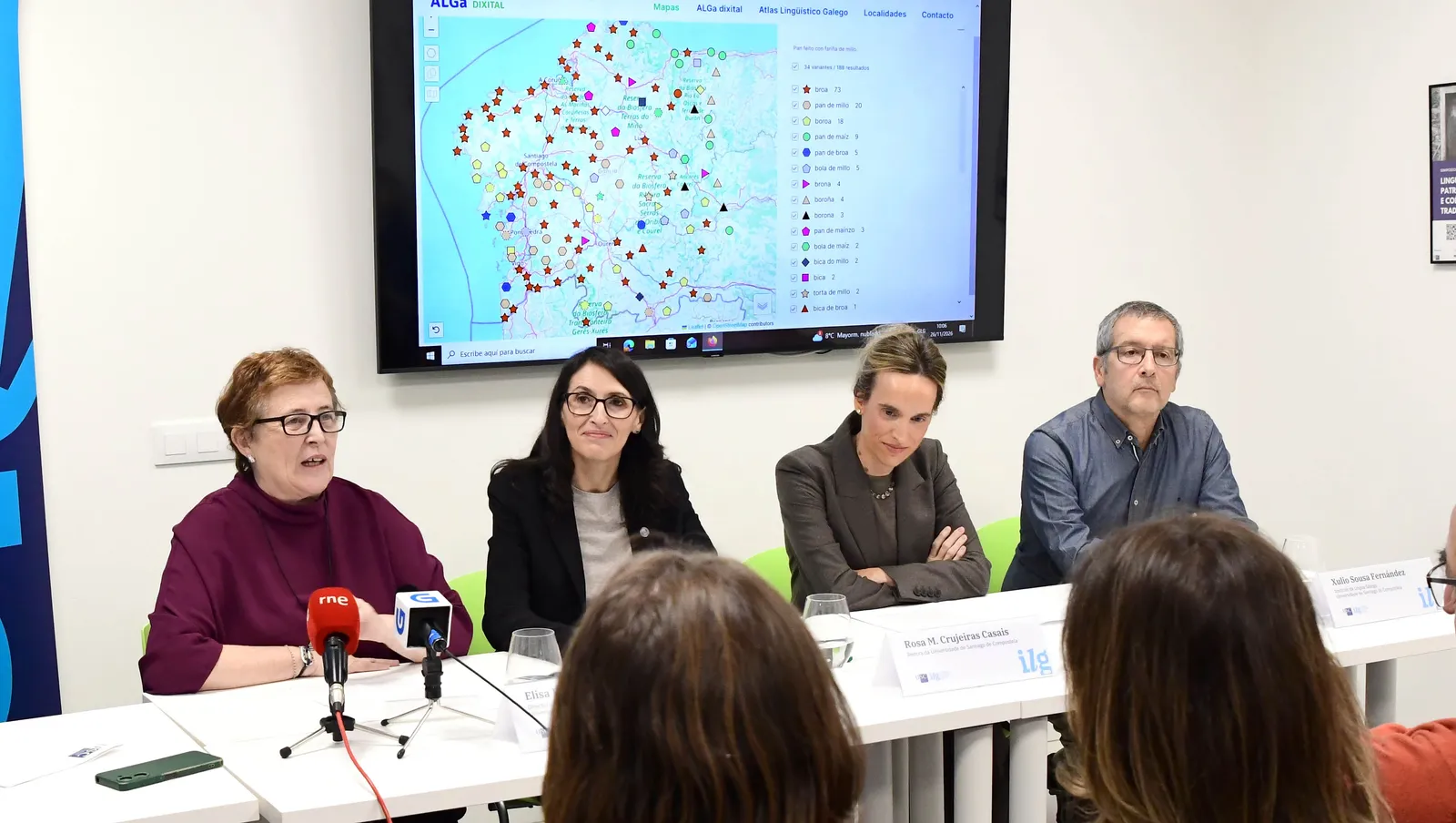
With the Digital ALGa, this documentary heritage acquires a new dimension. The platform allows users to consult and view a wide selection of published materials interactively, turning traditional atlas maps into a dynamic resource adaptable to each user's needs. The application organises content around three main thematic blocks: phonetics, morphology and syntax, and lexicon. From any of these areas, it is possible to locate specific phenomena and observe their geographical distribution through interactive maps.
Among the platform's main innovations is its customisation capability. Users can select specific variants, modify data visualisation, activate or hide information, and adapt the cartographic representation to their own interests. This flexibility facilitates not only point-in-time consultation but also the comparison and interpretation of linguistic phenomena from different perspectives.
Another highlighted feature of the Digital ALGa is the integration of the project's geographical dimension. The platform allows users to learn about the investigated localities and their location within the Galego linguistic domain, contributing to contextualising the data and better understanding the spatial distribution of the different documented linguistic forms.
The potential impact of the platform extends to multiple fields. For research, it constitutes a tool that facilitates the consultation and exploitation of linguistic data. For teaching, it offers a visual and interactive resource particularly useful for addressing dialectal diversity from an innovative perspective. For dissemination, it provides an opportunity to bring the knowledge of Galego linguistic richness and its territorial distribution to the public.
The platform also contributes to the preservation and enhancement of Galicia's intangible heritage. The data collected within the ALGa framework document linguistic forms, traditional names and local variants that form part of the collective memory of Galego-speaking communities. Their dissemination through a digital medium guarantees greater accessibility and encourages new forms of transmission and knowledge of this legacy.