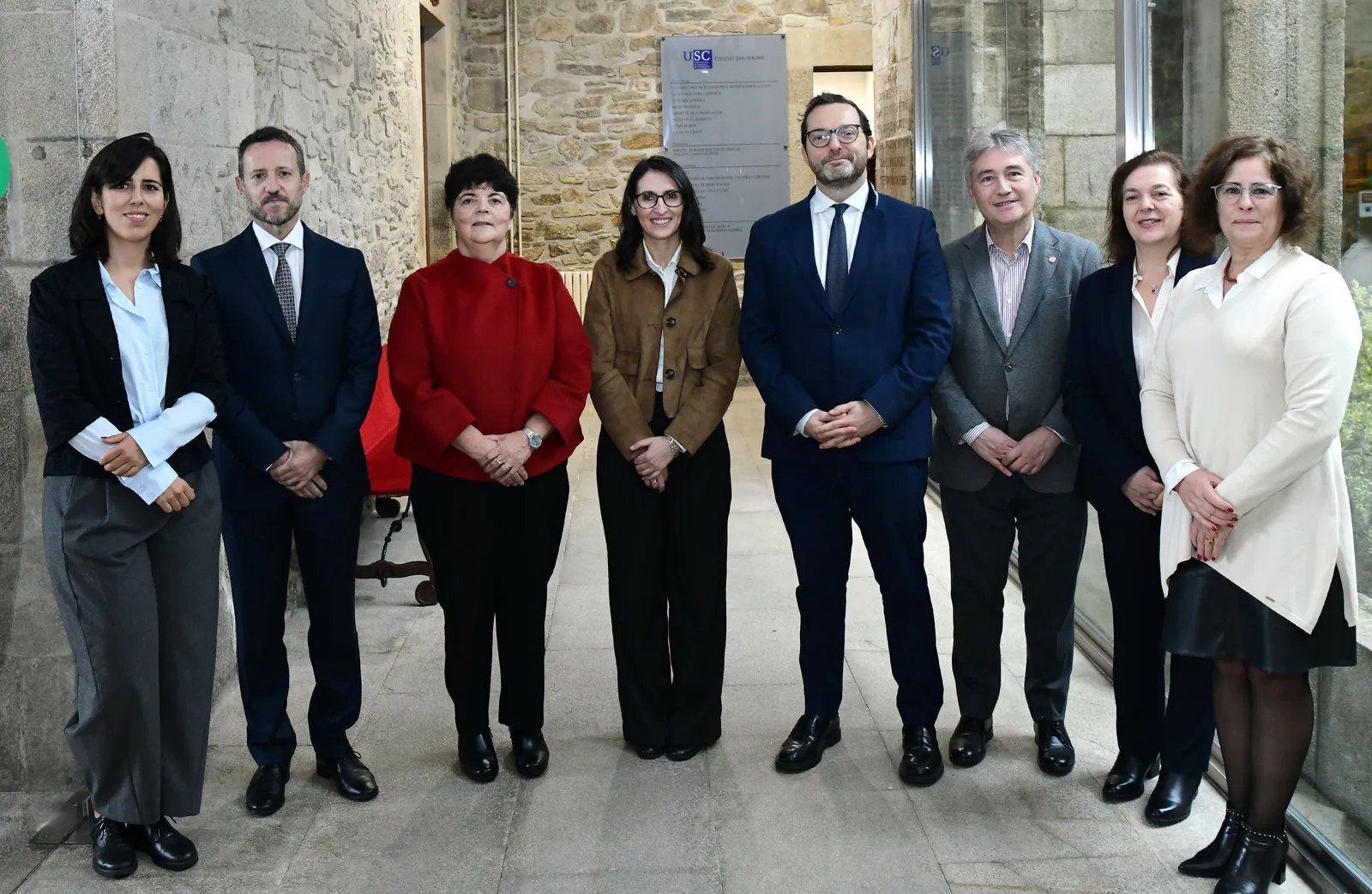
The University of Santiago de Compostela hosted last Tuesday, November 17th, the annual meeting of the CEER Foundation's Board. Rectors from the six public universities of the Galicia-North of Portugal Euroregion attended: USC, the University of Vigo, and the University of A Coruña, along with the Universities of Porto, Minho, and Trás-os-Montes e Alto Douro. The meeting served to renew the institutions' commitment to cross-border collaboration.
Also present were the Director of the CEER Foundation, Inês Gusman, and the Secretary General, Ana Paula Marques. The Board, the Foundation's main governing body, is the space where universities share priorities and coordinate their joint work. During the meeting, the Foundation's activities over the past year were reviewed, and strategic lines for 2027 were defined.
The handover of the presidency was formalized with the University of Porto ceding the role to the University of Santiago de Compostela, represented by its rector, Rosa M. Crujeiras. USC thus assumes the responsibility of continuing the shared work of the six higher education centers.
The CEER Foundation has been acting as a stable bridge between Galician and Portuguese institutions for over 20 years, facilitating university collaboration and participation in joint initiatives, which also involve administrations and other organizations from Galicia and Northern Portugal.
In the past year's review, the Foundation's work in consolidating European consortia, designing proposals, and strengthening cooperation networks with research groups, universities, and public and private entities was highlighted. The Foundation coordinates projects in programs such as SUDOE, Atlantic Area, and the Spain-Portugal cooperation program (POCTEP), in addition to exploring new funding avenues like the b-solutions initiative and Erasmus+.
Looking ahead, the CEER Foundation will continue to facilitate the mobility of students, faculty, and researchers among the six universities, promote joint training, and strengthen the institutions' common presence in European programs. It also aims to bring university research closer to territorial needs and increase the visibility of cooperation between universities on both sides of the border.