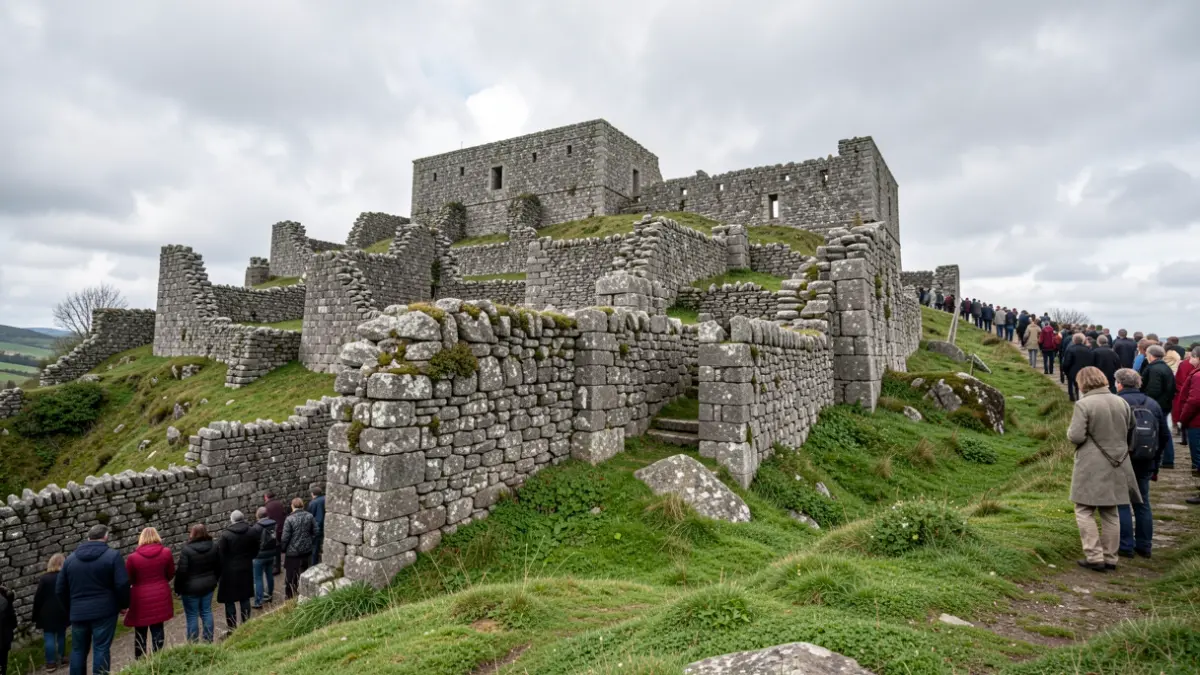
The archaeological team that has worked at the site since September 9th will explain the new discoveries and restoration efforts carried out during this intervention, funded by the Xunta with 30,000 euros through an agreement with the Concello de Portomarín.
The castro settlement of Castromaior, located near the village of the same name in the parish of Santa María de Castromaior, is a fortified Iron Age settlement of considerable size (over four hectares) and structural complexity, featuring walls, ditches, a central mound (croa), and several outer baileys (antecastros).
This year's campaign focused on excavating and restoring several areas reflecting the castro's occupation during the early Roman period, documenting a dwelling built over the inner rampart's pathway and spaces adjacent to a late structure facing the entrance.
The data provides insights into the settlement's transformations around the turn of the era and how social and economic changes with Rome's arrival influenced settlement patterns in castro communities. Following the excavation, restoration and conservation work was carried out for public display. It is a popular site for visitors, especially due to its proximity to the Camiño Francés (French Way).
The site was partially excavated between 2006 and 2009, and consolidated between 2020 and 2021. In 2023 and 2024, two excavation and consolidation campaigns were undertaken, focusing on the inner section of the eastern rampart.