Following the success of last year's postcard collection of parish churches, the Council is once again turning to art to send holiday greetings. This time, the focus is on the eight chapels scattered throughout the municipality, which will travel to convey best wishes for Christmas and the New Year. A print run of 1,600 postcards will be produced, with 200 copies of each illustration, also created this year by artist Blanca Escrigas. The postcards will be available to residents from early December at the Casa da Cultura and municipal offices.
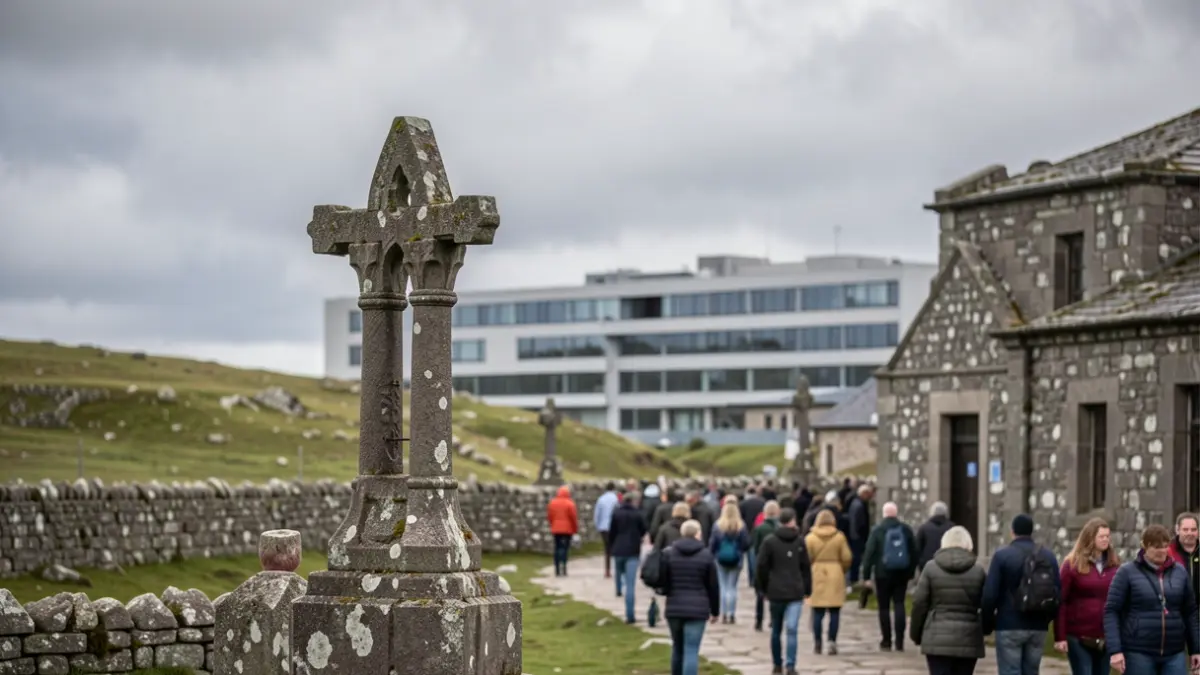
Blanca Escrigas thus completes her pictorial journey through the religious architecture of San Sadurniño, focusing on the chapel of Belén (San Sadurniño), Santa Mariña (Naraío), de la Esperanza (Santa Mariña do Monte), San Cristovo da Portela and San Cristovo de Ferreira, San Marcos de Amido, San Estevo do Camiño Arriba, and Santiago de Silvalonga. These eight structures, with diverse construction characteristics, are linked to ancient traditions and popular celebrations.
The artist, true to her way of interpreting landscape and architecture, offers a free and expressive vision of the chapels, combining watercolor, ink lines, and collage elements. Her compositions are characterized by deliberately irregular lines, color splashes, and textures reminiscent of cut or torn papers, giving each composition its own personality while maintaining a clear aesthetic unity throughout the series.
In the illustrations, Escrigas gives as much importance to the buildings as to their surroundings: bare trees, paths, meadows, cruceiros (stone crosses), and even everyday elements like posts, power lines, or converted bathtubs used as cattle troughs. These resources are not invented by Escrigas but contribute to replicating the landscape without idealizing it. The artist also plays with the contrasts between the tones of the stone, the white of the facades, and the wide variety of greens, blues, and ochres characteristic of the region.
Beyond their artistic value and function as Christmas greetings, the postcards are also an invitation to notice these small constructions that we see daily and which, precisely because of their familiarity, sometimes go unnoticed. Behind their walls lie stories of popular devotion, neighborhood gatherings, and customs passed down through generations, some of which are collected in the collective memory project Fálame de San Sadurniño.
The postcard designs are currently in the pre-press phase, which includes digitizing the original works and adapting their layout to the standardized format for Correos (the postal service). A print run of 200 copies of each chapel (1,600 postcards in total) will be made, printed with great detail and special care in color reproduction on high-grammage textured paper. This approach aims to achieve a finish that enhances the quality and texture of the illustrations, making the postcards as close as possible to the original drawings.
These small works of art can be collected free of charge from early December at the Casa da Cultura and the Council's offices, either to keep as souvenirs or to revive, in the age of WhatsApp, the custom of sending handwritten holiday greetings.