The Airis project, funded with a total of 568,906.62 euros through the 2023 public-private collaboration call by the State Research Agency of the Ministry of Science, Innovation and Universities, and with funds from the European Union's NextGeneration, aims to digitize and automate the inspection of railway infrastructure. The initiative, running since 2023, involves the Aerospace and Transport Systems group-Aerolab at UVigo and is coordinated by professor and researcher Higinio González.
During the opening of the session held at the Politécnico building, the vice-rector of the Ourense campus, Monserrat Cruz, highlighted the work done in a topic of public focus such as railway safety, emphasising the importance of real knowledge transfer from universities. Meanwhile, Antonio Baamonde, BIM implementation manager at Copasa, described the School of Aeronautical and Space Engineering as a "superstrategic ally" for the company, following six years of collaboration that also included the previous RIIM project.
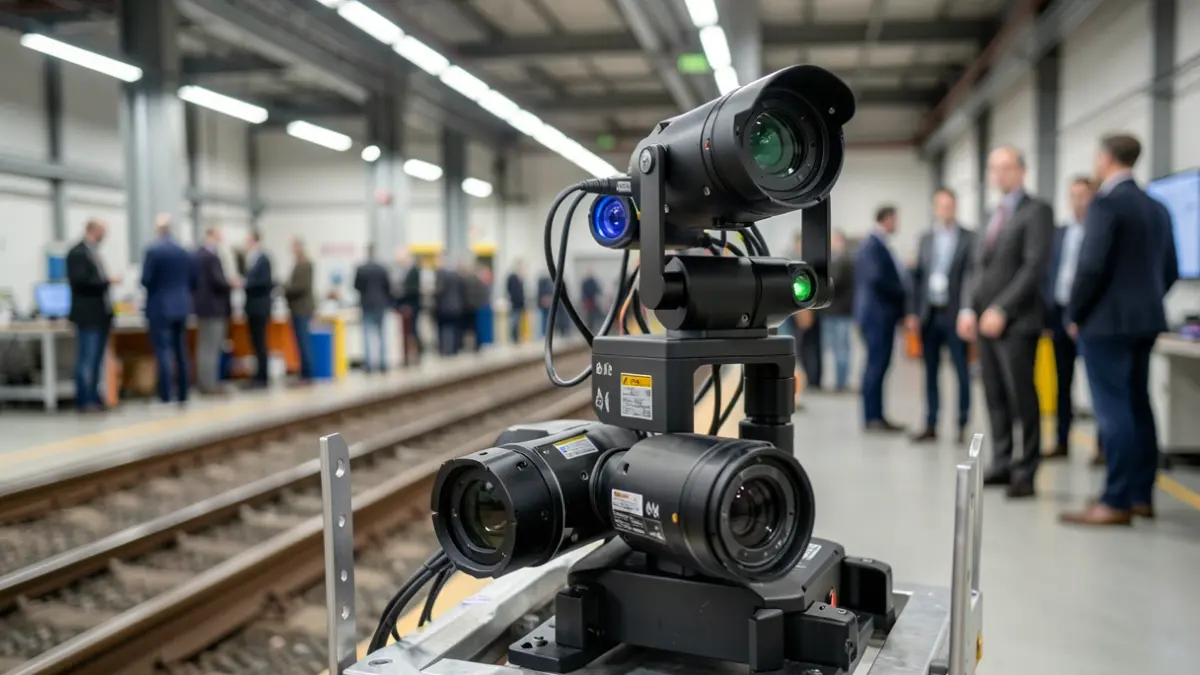
Project results highlight significant improvements in maintenance operation efficiency by reducing reliance on manual inspections and increasing the frequency of infrastructure assessment. The developed systems allow for faster identification of incidents that could evolve into critical defects. Among the five main results, the design of an intelligent inspection architecture capable of receiving data from optical sensors mounted on inspection trolleys stands out, along with the integration of LiDAR technologies for three-dimensional characterisation of the track.
The system demonstrated the ability to automatically identify various maintenance issues, including cracks in sleepers, missing bolts or clips, ballast geometry alterations, and the presence of foreign elements. Additionally, the project achieved real-time information processing directly on board inspection vehicles, maintaining operational capabilities at speeds up to 75 km/h and generating automatic alerts. The initiative consolidated a methodology based on continuous monitoring for the implementation of predictive maintenance strategies.
“"It is already six years of joint work with concrete results applicable to improvement in such a relevant field as railways."
In the final phase of the project, the UVigo team is now working on its continuation by seeking technological partners to advance towards the industrialisation of the developed prototype.