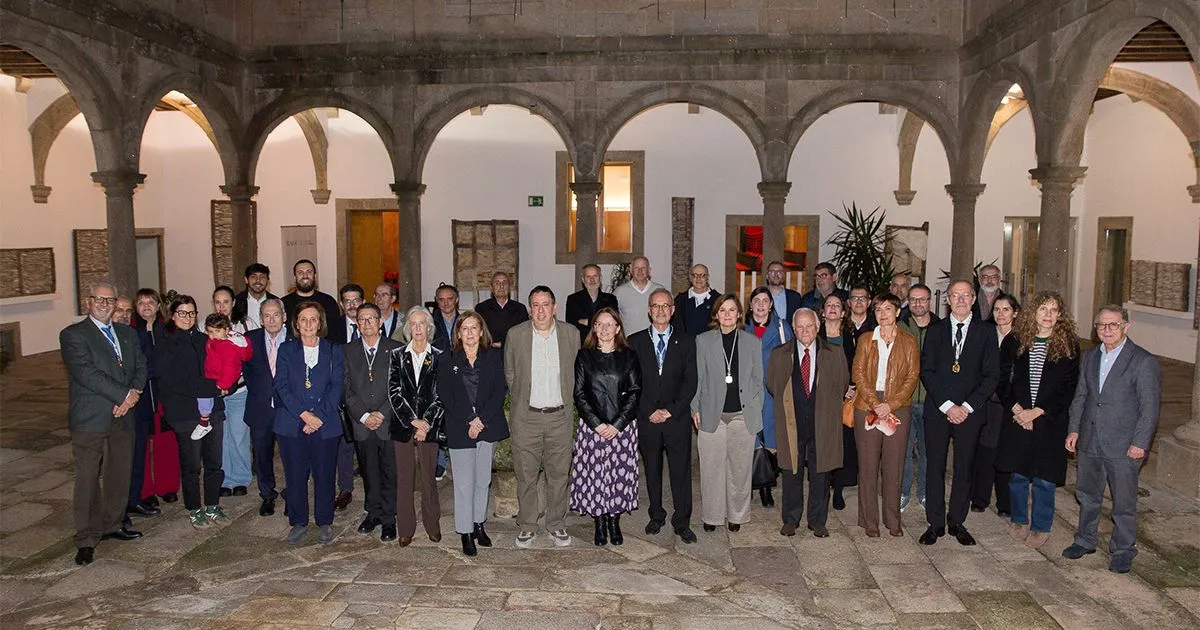
The researcher, one of the driving forces behind the creation of CiTIUS and a member of the center until 2020, currently works at the British technology multinational Arm. He holds a PhD in Physics from the University of Santiago de Compostela (USC) and was a professor at the universities of Oviedo, A Coruña, and Santiago de Compostela, where he directed the Institute of Informatics and the Department of Electronics and Computing. At 35, he became the first Chair of Computer Architecture and Technology in Galicia.
An internationally renowned specialist in computer arithmetic, his work focuses on developing faster, more efficient, and reliable processors. At Arm, he was part of the team responsible for designing a significant portion of the high-end processors incorporated into current mobile phones.
“"Javier is proof of something our students need to hear: that from a faculty in Santiago, one can reach the heart of technologies that are moving the world"
During his induction speech, titled The Processor as the Engine of the AI Revolution, Bruguera highlighted the decisive role of hardware evolution in the development of artificial intelligence. The new academic identified energy consumption as one of the main challenges of this technological transformation, noting that the development of low-power architectures allows the progressive transfer of AI model execution from the cloud to mobile devices, improving privacy and reducing response times.
“"Artificial intelligence must be developed with criteria of sustainability, transparency, equity, and privacy protection, oriented towards improving quality of life and expanding human capabilities"