CPR and Heimlich Maneuver Training Saves Lives in Santiago
Healthcare professionals provided knowledge on cardiopulmonary resuscitation and choking to over 200 people on World Cardiac Arrest Day.
By Xoán Otero Baamonde
••3 min read
AI
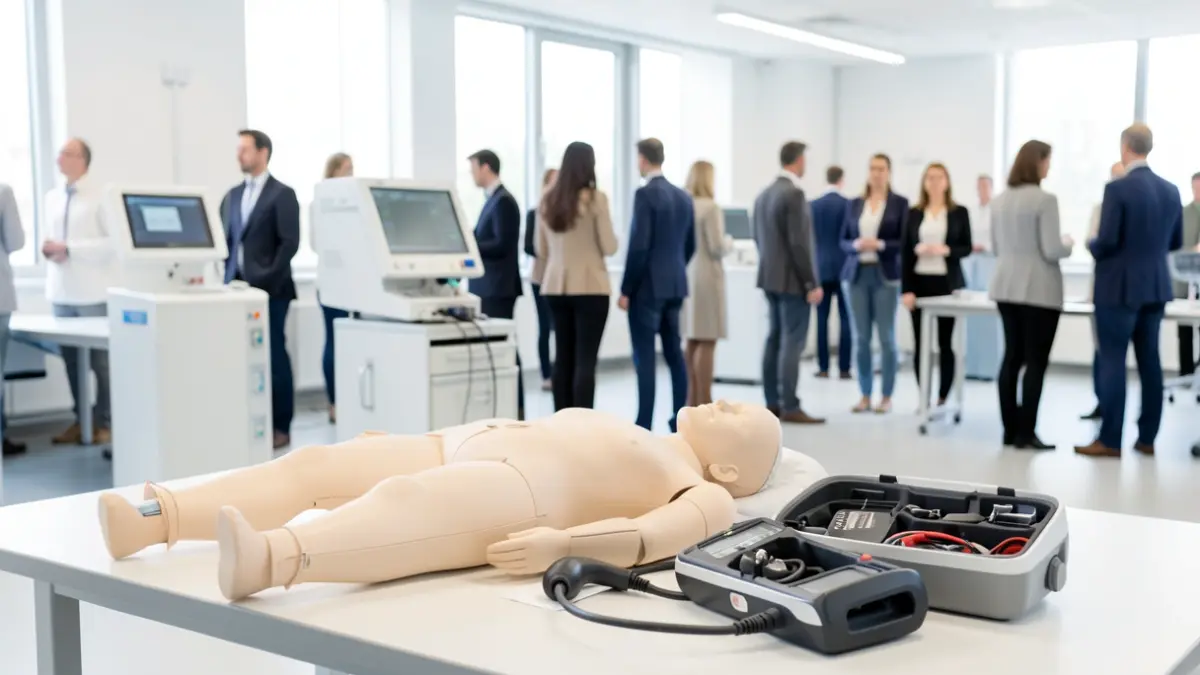
Generic image of a medical training dummy with a defibrillator nearby, in a bright, modern training room.
Over 200 individuals learned cardiopulmonary resuscitation (CPR) techniques and the Heimlich maneuver during training sessions organized by the Intensive Medicine Service of the Santiago de Compostela and Barbanza Health Area on World Cardiac Arrest Day.
Professionals from the Intensive Medicine Service of the Santiago de Compostela and Barbanza Health Area organized training and informational activities throughout the morning on the importance of cardiac massage and how to act in case of choking, aimed at the general population, patients, and families of hospitalized patients. This initiative coincided with the celebration of World Cardiac Arrest Day, commemorated today. Throughout the morning, over 200 interested individuals were able to learn, using 8 simulator manikins and semi-automatic defibrillators, basic and instrumentalized cardiopulmonary resuscitation (CPR) techniques, as well as how to perform the Heimlich maneuver – techniques that help save lives.
The activity, coordinated by Dr. Laura Sayagués, an intensivist at the Santiago Clinical Hospital and instructor for the National CPR Plan, and by Pedro Rascado, head of the Intensive Medicine Service for the Santiago health area, involved 10 instructors at various learning stations.
Cardiac arrest is a major public health problem, representing a situation where every minute counts. According to the Cardiovascular Health Strategy of the National Health System, it is estimated that approximately 30,000 out-of-hospital cardiac arrests occur annually in Spain, with a survival rate close to 10%. These figures highlight the need to continue advancing in the training of healthcare professionals and citizens, as rapid and appropriate intervention can radically change the prognosis for those affected.
Early recognition of cardiac arrest, alerting emergency services, initiating chest compressions, and using a defibrillator when available are fundamental actions, as each minute of delay in care can reduce survival chances by 10% to 12%.
“
"The new European resuscitation recommendations of 2025 emphasize the importance of strengthening the chain of survival and promoting accessible, continuous training programs adapted to different care settings. Our commitment: train to save lives."
“
"From our Intensive Medicine Service, we consider life support training a strategic line for improving care quality and patient safety. Since Dr. Sayagués took on the regional vice-coordination of the National Cardiopulmonary Resuscitation Plan (PNRCP) in 2023, we have driven significant teaching activity, training 4 official PNRCP instructors, conducting 20 editions of Immediate Life Support (SVI) courses, 1 advanced course, 1 instructor course for SVA, as well as multiple on-site training activities in various hospital wards, ACIS courses, and periodic accredited intra- and extra-hospital training at CESIS (medical simulation center located at Gil Casares hospital), which have already benefited over 600 professionals."
This initiative aims to bring cardiopulmonary resuscitation knowledge and skills into the professionals' usual work environment, promoting early recognition of clinical deterioration, identification of risk situations, and coordinated response to cardiac arrest. The short- to medium-term goal is to consolidate a transversal life support training program, progressively reaching professionals in various hospital units and services.
“
"The response to cardiac arrest does not begin when the specialized team arrives, but at the moment any professional recognizes the emergency and initiates the first actions."
“
"Excellence in critical patient care depends not only on technology or available resources but also on the preparation, coordination, and response capacity of all professionals."
“
"Because with cardiac arrest, every minute matters, every professional counts, and every trained person can make a difference, from our Intensive Medicine Service, we will continue working to make life support training increasingly accessible, transversal, and close to daily clinical practice."