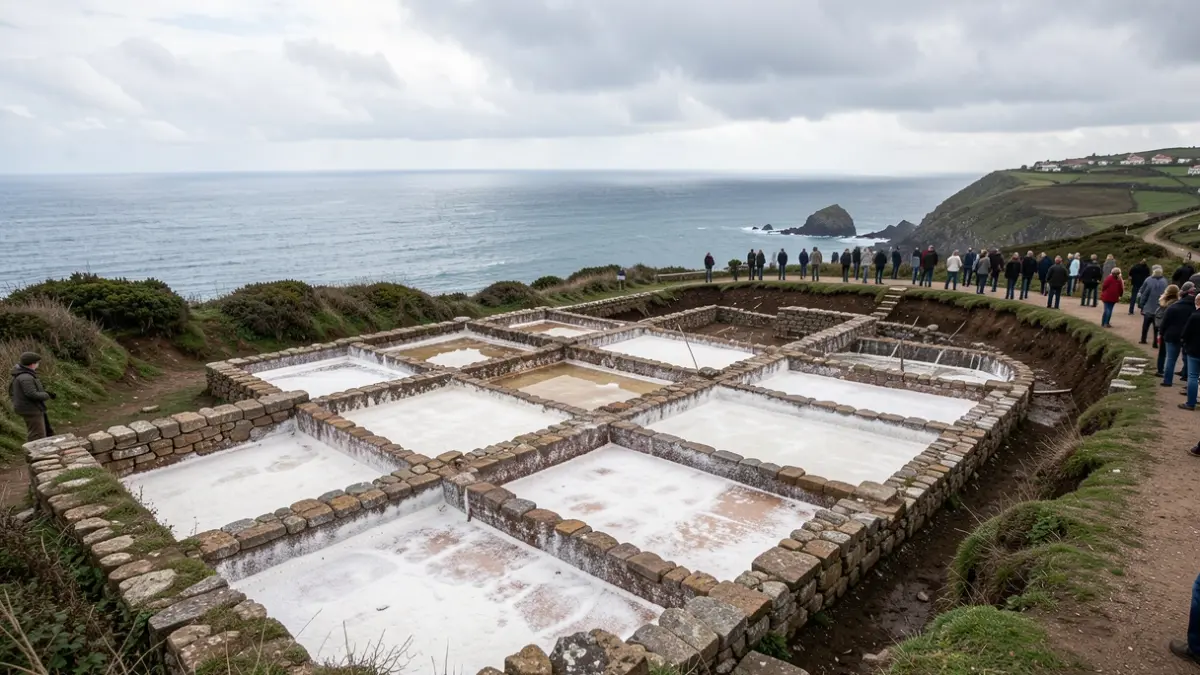
Archaeological work carried out in recent weeks at the Aguncheiro site in Mougás has revealed the pavement of an ancient salt production facility and associated structures, including remnants of walls that delimited crystallization tanks. The intervention, executed by Tempos Arqueólogos, covered an area of 100 square meters.
This discovery confirms the archaeological potential previously indicated by a ground-penetrating radar survey by Allen Gontz, a professor at Clarkson University (New York), which suggested the site might cover approximately 4,000 square meters. Future campaigns will determine the true extent of the Roman salt pan.
Brais X. Currás, a researcher at the CSIC's Institute of History, described the results as "very positive," emphasizing that they support the hypothesis of numerous salt exploitation sites along the Atlantic coast of ancient Gallaecia. He noted that the Aguncheiro salt pan is an "exceptional" example of Roman salt production, given the scarcity of known structures from that period elsewhere.
The mayor of Oia, Cristina Correa Pombal, highlighted the discovery's significance for the municipality's heritage and cultural and tourist development, adding a new attraction to the recently opened Pedra Rubia recreational area.
The work is part of the "Camiños do Sal" (Paths of Salt) project, promoted by the Oia Council to investigate, excavate, conserve, and valorize ancient Roman salt pans. The initiative has a total investment of 119,343.65 euros, largely funded by a European Union grant through the European Maritime, Fisheries and Aquaculture Fund (EMFAF).
The next phase, planned for spring 2027, will expand the excavation area and include consolidation and conservation efforts. The project also involves outreach activities such as guided tours, educational programs, and informative panels, aiming to make Aguncheiro a key site for understanding ancient salt production and its importance to coastal communities.