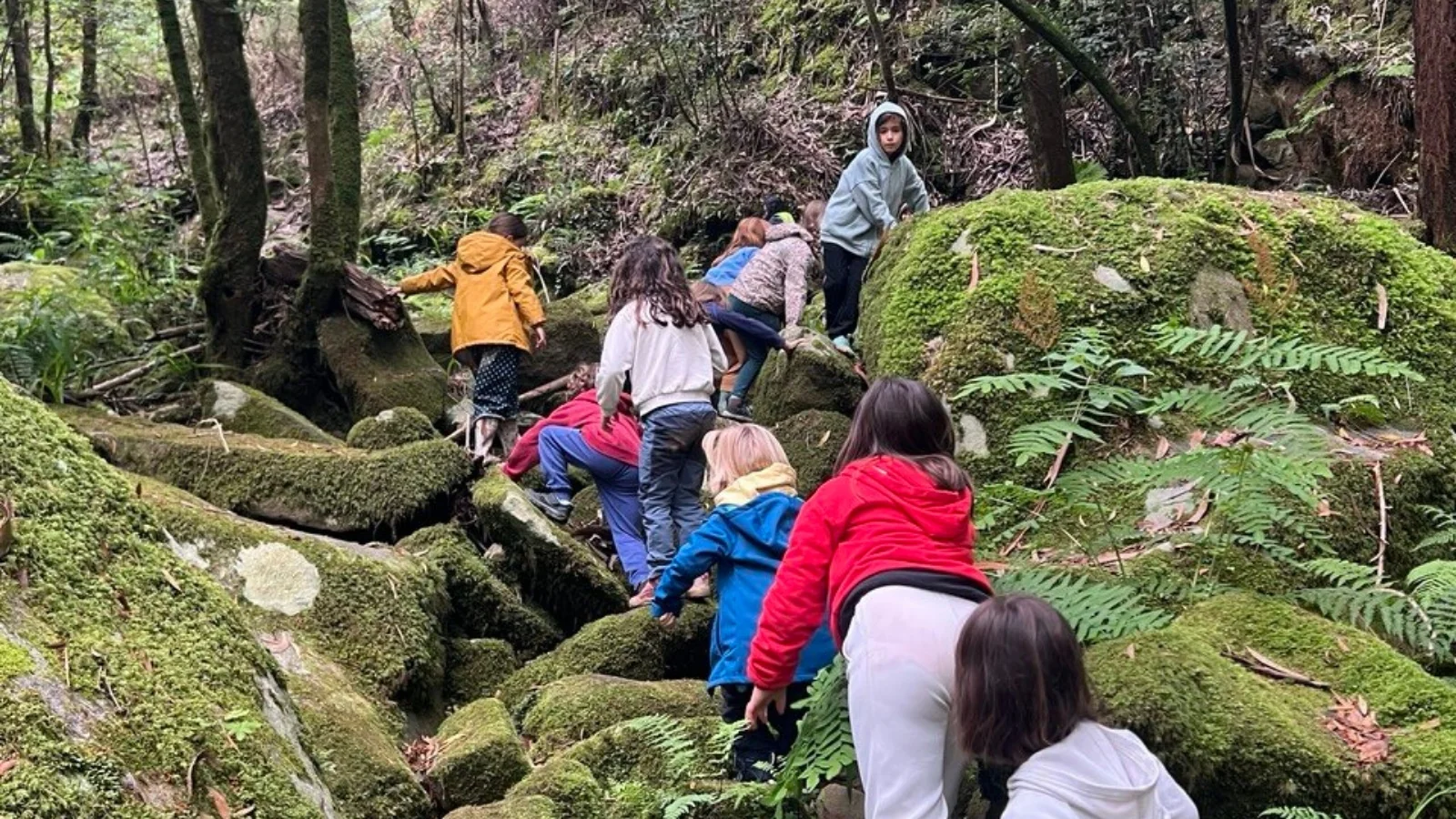
On Fridays, lessons at Gándara International School move outdoors. Depending on the week, the classroom is a beach, a forest or a riverbank. Some of the children on those outings were born a few kilometres away. Others arrived in Galicia from Mexico, Argentina, Uruguay, South Africa, the United States or Hungary, and the list does not end there.
The school stands in Mañufe, a rural parish of Gondomar, a 25-minute drive south of Vigo and 10 minutes from the beaches of Nigrán and Baiona. It teaches children aged 3 to 12, is authorised by the Xunta de Galicia as a foreign school and has been accredited since 2022 by the New England Association of Schools and Colleges (NEASC), a US accrediting body founded in 1885. It is the only NEASC-accredited school in the south of Galicia.
What started in 2013, when two mothers went looking for a different kind of education, is today a small and cosmopolitan community. Families who have lived in the Val Miñor for generations share the school gate with others who have just arrived from another continent.
Why families moving to Spain are looking at Galicia
Galicia is growing again. The region reached 2.73 million inhabitants in 2026, its highest figure in eleven years, and the regional government puts the growth down to a record migration balance: people arriving from abroad and from other parts of Spain, including Madrid, Catalonia and the Basque Country. Figures from the National Statistics Institute (INE) show that the number of foreign residents rose by more than 19,000 in the year to July 2026, to over 203,000.
For a family moving with children, the first search is nearly always the same: an international school. In Galicia, that list is short.
"The families who come here are not looking for a bubble," says Pablo Pazos, co-director of the school and the father of two of its pupils. "They want their children to learn in English and, at the same time, to make friends in the village, speak Spanish and Galician and feel that this is home. A small school can do that because every child here is known by name."
English, Spanish and Galician in the classroom, with wellbeing first
Three languages are spoken in every classroom at Gándara, and the teaching team speaks all three. The aim is for English to be the main language of the classroom, taking up between 40% and 50% of learning time depending on age, while Spanish and Galician are part of every school day. But that aim never comes before a child's social and emotional wellbeing. When the school has to choose between the language and the child, it chooses the child.
The school is unusually frank about what parents can expect: it does not promise native-level bilingualism, but real progress, measured against the European framework for languages (CEFR). Children do not need to speak English to join.
A small school by design
Gándara takes a maximum of 80 pupils, with one teacher for every 10 to 12 children. Its approach is inspired by Montessori: prepared classrooms, hands-on materials and children who choose their work and move at their own pace, with no graded exams and no routine homework. The grounds cover more than 5,000 square metres, with a vegetable garden, a mud kitchen and trees to climb.
For a child starting again in a new country, that scale matters. Nobody stays "the new one" for long.
Fees, timetable and how to visit
Fees for the 2026-27 school year are €450 a month for ages 3 to 5, €520 for ages 6 to 8 and €550 for ages 9 to 11, and they are published in full on the school's website. The school day runs from 8:45 to 14:00, with optional early drop-off from 8:15, lunch and afternoon activities. Admission begins with a visit and a conversation with the family.
Visits take place on weekdays, by appointment, at Lugar de Moureira 1, Mañufe, Gondomar (Pontevedra). Families looking for an international school in Galicia, near Vigo or anywhere in Spain can book one at gandaraschool.com and follow daily school life on Instagram at @gandaraischool.