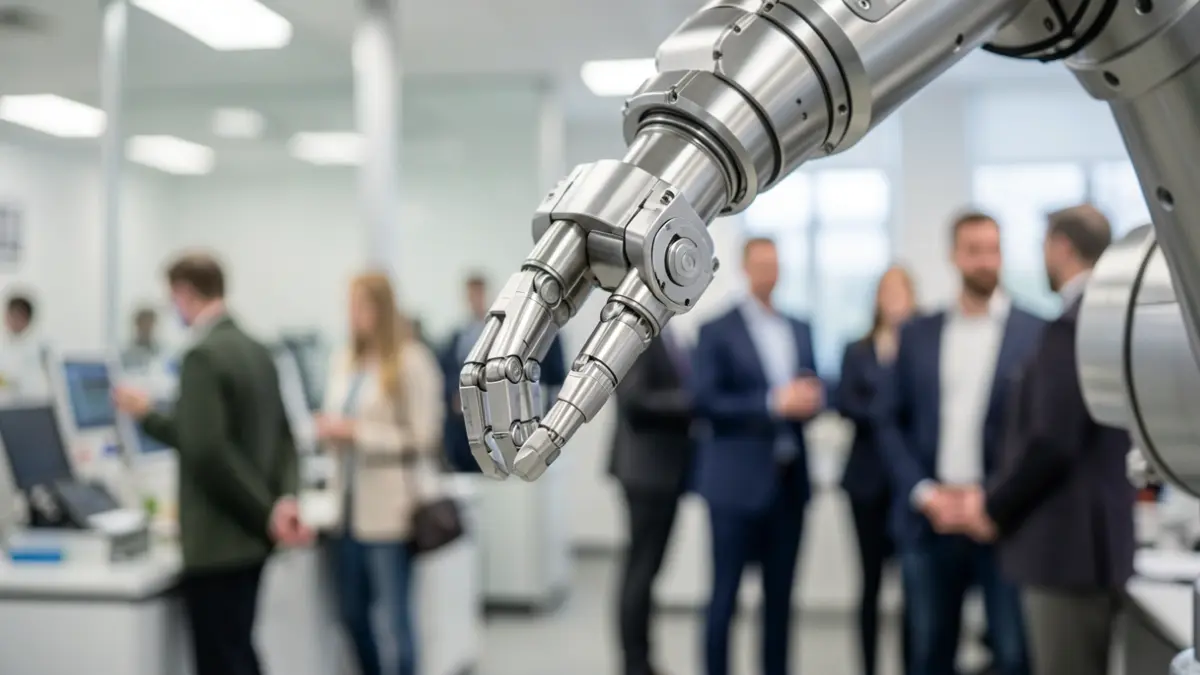
The European project PILLAR-Robots, coordinated by the Universidade da Coruña through the Research Center in Information and Communication Technologies (CITIC), has developed autonomous systems capable of acquiring new skills and adapting their behavior to human needs. After four years of research, the program aims for more flexible, secure, and human-purpose-aligned robotics.
The research, funded by the Horizon Europe program with nearly four million euros, has focused on robots that learn continuously and expand their capabilities, adapting to different environments and interactions. A cognitive architecture, e-MDB, has been developed, allowing robots to generate their own goals and strategies, keeping their learning aligned with human purposes through open-ended learning.
The architecture has been implemented in three demonstrators: in the agri-food sector, robots manipulate fruits and vegetables; in education and entertainment, applications have been developed for learning programming with the Robobo robot and a museum guidance system with the TIAGo robot; and in industrial environments, work has been done on robotic systems for operating in non-automated spaces and adapting to changing tasks, including QD-Grasp algorithms and an assistant robot.
The results were presented at the European forum AI, Data and Robotics Forum (ADRF) 2026 in Porto, where the principal investigator, Richard Duro, also spoke at a workshop on the challenges of transferring autonomous robotics from labs to industry. The project also published a Policy Brief with recommendations for artificial intelligence, data, and robotics policies, focusing on human supervision, security, privacy, and equitable access to technology.
The PILLAR-Robots consortium has brought together six partners from Spain, France, Italy, and Greece over four years: CITIC of UDC, Sorbonne University, the National Research Council (CNR), the Greek center Athena, and the companies PAL Robotics and AI2Life. The collaboration has combined expertise in robotics, artificial intelligence, and human-robot interaction.